|
 2a.
What is Radioactivity?
and why does it happen? 2a.
What is Radioactivity?
and why does it happen?
- The nucleus is composed of protons and
neutrons
and glued together by a strong nuclear attractive
forces BUT only certain combinations of the neutron/proton (n/p) ratio
in the nucleus seem to be more stable than others (see stability curve graph
on right).
- Any isotope of any element that does not lie in the
stability band with a stable n/p ratio is more likely to be radioactive!
- Radioactivity
results from the random and spontaneous breakdown of the unstable nucleus of an atom.
- This breakdown is called radioactive decay
(nuclear decay)
of the unstable nucleus of the atom-isotope (radioisotope).
- In the breakdown of the unstable nucleus, energy is released by the emission
(usually) of
three types of ionising radiation (nuclear radiation) called alpha
particle radiation, beta particle radiation and gamma radiation
(see diagram below).
- These emissions are ALL high velocity and high
energy particles or radiation.
-
 Alpha particles are
positive (2+), mass 4, 2 protons (+) combined with 2 neutrons (0). Alpha particles are
positive (2+), mass 4, 2 protons (+) combined with 2 neutrons (0).
-
The expelled
alpha particle is the equivalent of the nucleus of a
helium atom (which is what it is!)
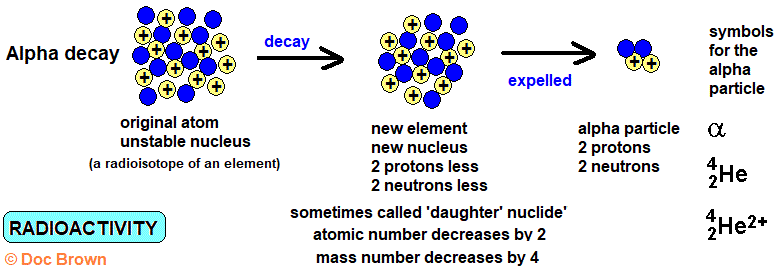
-
 Beta
particles are negative, mass 1/1850,
a negative electron (charge -, minus), 0-1e. Beta
particles are negative, mass 1/1850,
a negative electron (charge -, minus), 0-1e.
-
The
expelled beta minus particle from the unstable nucleus is a high speed
electron.
-
(you should
state that this electron is a beta minus, because there is beta plus
particle called a positron!

-
 Gamma photon, mass 0 (~zero), radiation is electrically neutral (charge 0 or zero) Gamma photon, mass 0 (~zero), radiation is electrically neutral (charge 0 or zero)
- Gamma radiation emission often accompanies alpha and
beta particle emission - its a way that a newly formed and temporarily
unstable nucleus gets rid of its excess energy to become more stable.

- When an unstable nucleus splits a
different nucleus with a different number of protons is formed, as
well as the emission of radiation, and
so a different element is formed (NOT possible in chemical changes, but
this is a nuclear reaction!).
- The breakdown of an unstable atom is referred to as
radioactive decay or radioactive disintegration.
- It is a totally random process meaning it is a
matter of chance which particular nucleus decays.
-
For
more details about
radiations, see
 detailed table of information in
4a. on the three types of radioactive emission, alpha, beta and
gamma ionising radiations. detailed table of information in
4a. on the three types of radioactive emission, alpha, beta and
gamma ionising radiations.
- Because it involves high energy nuclear changes, radioactivity is completely unaffected by the temperature, pressure, physical state or chemical state of the atoms.
-
You cannot alter the rate of decay at all!
- The energy changes involved with
nuclear changes like radioactivity, are much greater, than
those for physical or chemical changes of materials like boiling or
fuel combustion etc.
- I've some calculations in
section 4. to prove this point
(but NOT required by GCSE students!).
2b. How
did they find out there were three types of atomic ionising radiation?
Basic experimental technique for
separating beams of a mixture of particles
-
 A radium source was used, which
also contains other radio-isotopes, and a lead casing was the only
safety precaution used! A radium source was used, which
also contains other radio-isotopes, and a lead casing was the only
safety precaution used!
- How people like Marie Curie and Ernest
Rutherford etc. survived beyond the age of 60 is a mystery!
- Anyway! it was found that the
original 'emission' from the radioactive radium source was split into three beams
by an electric or magnetic field (diagram on the right).
- (i) The alpha beam was attracted/deflected
towards a negative plate, showing it was positive, since opposite
charges attract/like charges repel - the rules of electric charge
interaction.
- (ii) The beta (negative electrons) beam bent
towards a positive plate (showing it was negative).
- (iii) The gamma beam passed through
un-deflected (showing it had no charge).
- Note: Although the alpha
particles have the biggest charge of +2, the beta beam (smaller
charge of -1) is more easily deflected because of its much smaller
mass (nearly 8000 x smaller, mass ratio for He2+ : e-
is 4 : 1/1850).
- Note that in other nuclear
particle separation experiments, a proton (+), or any other positive
particle beam, bends towards the negative plate.
- Other experiments have detected positron
(positive electron) emission from beta plus radioactive decay.
Key revision points about What
is Radioactivity? Why does it happen? How do we know there 3 types of emitted
radiation?
See the main index for all the detailed
notes on radioactivity
1. What is
Radioactivity?
- Definition:
The spontaneous emission of particles or energy from unstable atomic
nuclei.
- Key idea:
Atoms with too many protons or neutrons (or too much energy) are
unstable and decay to become more stable.
- Random process:
Individual decays cannot be predicted, but overall rates follow
statistical patterns (half-life).
2. Why Does
Radioactivity Happen?
- Nuclear instability:
Balance between strong nuclear force (binding protons & neutrons)
and electrostatic repulsion of protons.
- Too many neutrons/protons
→ nucleus unstable.
- Decay pathways:
- Emit particles (α, β) or
energy (γ) to reduce instability.
- Transform into a different
element (transmutation).
3. How Do
We Know There Are 3 Types of Radiation?
- Historical experiments
(Rutherford, early 20th century):
- Radiation passed through
electric/magnetic fields → separated into three distinct paths.
- Alpha (α):
Deflected slightly, positive charge.
- Beta (β−):
Deflected strongly, negative charge.
- Gamma (γ):
No deflection, neutral, electromagnetic wave.
4. Typical
Misconceptions
- Forgetting gamma has no
mass/charge.
- Misbalancing nuclear equations
(e.g., omitting electron in β decay).
- Assuming all isotopes are
radioactive (many are stable).
- Believing radiation makes atoms
“explode” — decay is subtle, not explosive.
5. Final
key point
Radioactivity is the natural
consequence of nuclear instability.
Experiments with electric/magnetic
fields revealed three distinct types of radiation, each with unique
properties.
See the main index for all the detailed
notes on radioactivity
What next?
Associated Pages
RADIOACTIVITY
and NUCLEAR PHYSICS NOTES INDEX
See also
Electromagnetic radiation,
types, properties, uses and dangers
GCSE
Level (~US grade 8-10) School Physics Notes
(students age ~14-16)
GCSE
Level (~US grade 8-10) School Chemistry Notes
(students age ~14-16)
Find your GCSE
science course for more help links to revision notes
ALL my Advanced Level pre-university
Chemistry Notes
(students aged ~17-18)
Email doc
brown - comment? query
Atomic structure, radioactivity and
nuclear physics revision notes index
Atomic structure, history, definitions,
examples and explanations including isotopes
1. Atomic
structure and fundamental particle knowledge needed to understand radioactivity
2.
What
is Radioactivity? Why does it happen? Three types of atomic-nuclear-ionising radiation
3.
Detection of
radioactivity, its measurement
and radiation dose units,
ionising
radiation sources
- radioactive materials, background radiation
4.
Alpha, beta & gamma radiation - properties of 3 types of radioactive
nuclear emission & symbols
,dangers of radioactive emissions - health and safety issues and ionising radiation
5.
Uses of radioactive isotopes emitting alpha, beta (+/–) or gamma radiation in
industry and medicine
6. The half-life of a radioisotope - how
long does material remain radioactive? implications!, uses of decay data and half-life values
-
archaeological radiocarbon dating, dating ancient rocks
7. What
actually happens to the nucleus in alpha and beta radioactive decay and why? nuclear
equations!, the
production of radioisotopes - artificial sources of radioactive-isotopes,
cyclotron
8.
Nuclear
fusion reactions and the formation of 'heavy elements' by bombardment techniques
9.
Nuclear Fission Reactions, nuclear power
as an energy resource

RADIOACTIVITY
multiple choice QUIZZES and WORKSHEETS
Easier Foundation
Tier Radioactivity multiple choice QUIZ
Harder Higher
Tier Radioactivity multiple choice QUIZ
Worksheet QUIZ Question 1 on
RADIOACTIVITY - absorption of alpha, beta and gamma radiation
Worksheet QUIZ Question 2 on
RADIOACTIVITY - dangers & monitoring ionising radiation levels
Worksheet QUIZ Question 3 on
RADIOACTIVITY - revision of atomic structure
Worksheet
QUIZ Question 4 on RADIOACTIVITY -
what happens to atoms in radioactive decay?
Worksheet QUIZ Question 5 on
RADIOACTIVITY - uses of radioisotope and half-life data
ANSWERS to the WORD-FILL WORKSHEET QUIZZES
Crossword
puzzle on radioactivity
and
ANSWERS!
|
Website content © Dr
Phil Brown 2000+. All copyrights reserved on Doc Brown's Chemistry
and Doc Brown's Physics revision notes, images,
quizzes, worksheets etc. on radioactivity, causes, effects, uses and
other aspects of nuclear physics for GCSE physics.
Website content © Dr
Phil Brown 2000+. All copyrights reserved on Doc Brown's Chemistry revision notes, images,
quizzes, worksheets etc. Copying of website material is NOT
permitted. Exam revision summaries & references to science course specifications
are unofficial. keywords and phrases:
revision study notes based
on the syllabus-specifications for students taking the IGCSE/GCSE
level chemistry examinations revision notes on explaining what is
radioactivity? how was it detected?
, revision notes on explaining
what is radioactivity? how was it detected? based on the syllabus-specifications for students
taking the IGCSE/GCSE level chemistry examinations on
explaining what is radioactivity? how was it detected? for the gcse chemistry revision notes on
explaining what is radioactivity? how was it detected?, AQA igcse/gcse chemistry notes
on explaining what is radioactivity? how was it detected?, Edexcel gcse
notes on explaining what is radioactivity? how was it detected?, OCR 21st century chemistry revision
notes on explaining what is radioactivity? how was it detected?, OCR gateway GCSE chemistry revision notes on
explaining what is radioactivity? how was it detected?, CIE Cambridge igcse chemistry
revision notes on explaining what is radioactivity? how was it detected?, WJEC gcse chemistry revision notes on
explaining what is radioactivity? how was it detected?,
CCEA gcse revision notes for students on explaining what is
radioactivity? how was it detected?, revision notes for US grade 9-10 chemistry courses
Website content © Dr
Phil Brown 2000+. All copyrights reserved on Doc Brown's Physics revision notes, images,
quizzes, worksheets etc. Copying of website material is NOT
permitted. Exam revision summaries & references to science course specifications
are unofficial. keywords and phrases:
revision study notes based
on the syllabus-specifications for students taking the IGCSE/GCSE
level physics examinations revision notes on explaining what is
radioactivity? how was it detected?
, revision notes on explaining
what is radioactivity? how was it detected? based on the syllabus-specifications for students
taking the IGCSE/GCSE level physics examinations on explaining what is
radioactivity? how was it detected? for the gcse physics revision notes on
explaining what is radioactivity? how was it detected?, AQA igcse/gcse physics notes on
explaining what is radioactivity? how was it detected?, Edexcel gcse
notes on explaining what is radioactivity? how was it detected?, OCR 21st century physics revision
notes on explaining what is radioactivity? how was it detected?, OCR gateway GCSE physics revision notes on
explaining what is radioactivity? how was it detected?, CIE Cambridge igcse
physics
revision notes on explaining what is radioactivity? how was it detected?, WJEC gcse physics revision notes on
explaining what is radioactivity? how was it detected?,
CCEA gcse revision notes for students on explaining what is
radioactivity? how was it detected?, revision notes for US grade 9-10
physics courses
Website content © Dr
Phil Brown 2000+. All copyrights reserved on Doc Brown's Chemistry revision notes, images,
quizzes, worksheets etc. Copying of website material is NOT
permitted. Exam revision summaries & references to science course specifications
are unofficial. keywords and phrases:
revision study notes based
on the syllabus-specifications for students taking the A level
chemistry examinations revision notes on explaining what is
radioactivity? how was it detected?
, revision notes on explaining
what is radioactivity? how was it detected? based on the syllabus-specifications for students
taking the A level chemistry examinations on explaining what is radioactivity?
how was it detected? for the A level chemistry revision notes on
explaining what is radioactivity? how was it detected?, AQA
A level chemistry notes on explaining what is radioactivity? how was
it detected?, Edexcel A level notes on explaining what is
radioactivity? how was it detected?, OCR A
level chemistry revision
notes on explaining what is radioactivity? how was it detected?, Salters & OCR A level chemistry revision notes on
explaining what is radioactivity? how was it detected?, CIE Cambridge
A level chemistry
revision notes on explaining what is radioactivity? how was it detected?, WJEC A level chemistry revision notes on
explaining what is radioactivity? how was it detected?,
CCEA A level revision notes for students on explaining what is
radioactivity? how was it detected?, revision notes for US grade
11-12 K12 AP Honors chemistry courses
Website content © Dr
Phil Brown 2000+. All copyrights reserved on Doc Brown's Physics revision notes, images,
quizzes, worksheets etc. Copying of website material is NOT
permitted. Exam revision summaries & references to science course specifications
are unofficial. keywords and phrases:
revision study notes based
on the syllabus-specifications for students taking the A level
physics examinations revision notes on explaining what is
radioactivity? how was it detected?
, revision notes on explaining
what is radioactivity? how was it detected? based on the syllabus-specifications for students
taking the A level physics examinations on explaining what is radioactivity? how
was it detected? for the A level physics revision notes on
explaining what is radioactivity? how was it detected?, AQA
A level physics notes on explaining what is radioactivity? how was
it detected?, Edexcel A level notes on explaining what is
radioactivity? how was it detected?, OCR A
level physics revision
notes on explaining what is radioactivity? how was it detected?, Salters & OCR A level physics revision notes on
explaining what is radioactivity? how was it detected?, CIE Cambridge
A level physics
revision notes on explaining what is radioactivity? how was it detected?, WJEC A level physics revision notes on
explaining what is radioactivity? how was it detected?,
CCEA A level revision notes for students on explaining what is
radioactivity? how was it detected?, revision notes for US grade
11-12 K12 AP Honors physics courses |
What next?
Associated Pages
|
 alpha particle emission on left